
Research
Research & Standards
Architectural research, published doctrine, and standards contributions that ground AID Edge's engineering in industry practice — not isolated theory.
Doctrine & Methodology
Telecom Reliability Engineering Doctrine (TRED)
The AID Edge Telecom Reliability Engineering Doctrine (TRED) defines how operational reliability decisions are governed across existing telecom networks, including 4G, 5G, and Hybrid RAN-Core environments.
In an industry where telemetry is abundant but certainty is scarce, TRED shifts the operational focus from monitoring more to deciding better. This is not a product manual and not a marketing whitepaper — it is a decision governance framework for managing human and automated intervention in probabilistic, physics-constrained systems.
Breaking False Calm
False Calm is not a simple monitoring gap; it is a structural outcome of metric-centric visibility. When degradation remains intermittent, partial, or below static alarm thresholds, traditional systems smooth away early warning signals — dashboards stay green while operational risk accumulates silently.
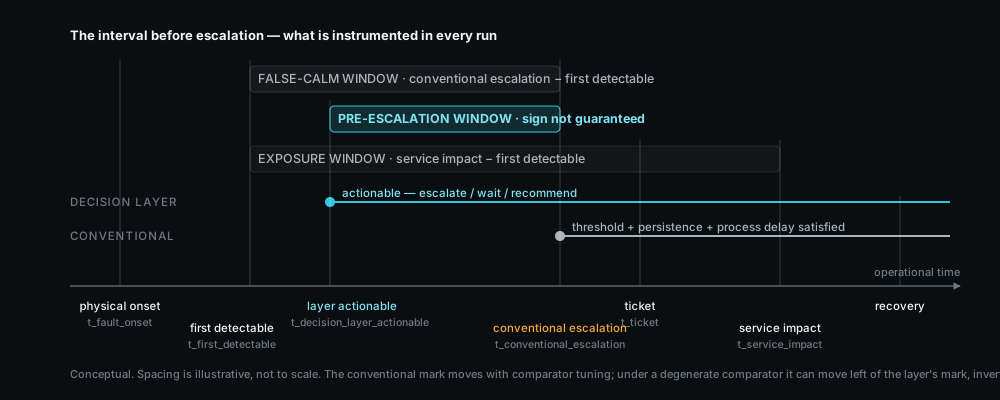
The interval between the first detectable signal and conventional escalation.
The correct operational posture is selective: silence in the presence of noise, and early warning only when correlated behavior indicates a predictable service impact before alarms exist.
Foundations and Validation
TRED is grounded in Standard Alignment (3GPP-aligned KPIs and operational fault management principles), applying peer-informed operational methodology to define how reliability decisions are governed across live telecom environments.
Standards & Publications
Contributing to the frameworks our industry relies on
See the full publications library for company-level research, standards commentary, and technical writing.
IEEE P1947™ Quantum Cybersecurity Framework
AID Edge contributed to the IEEE P1947™ Working Group on quantum cybersecurity standards (2025).
Why AI, Satellites, and Telecom Are Rewriting the Physics of Profit
Technical commentary on the economics of AI-driven satellite and telecom infrastructure.
Read the publication (PDF) →What's established vs. what we contribute
AID Edge's research builds on established, cited physics and methodology — rain attenuation and path loss models, adaptive coding and modulation, orbital mechanics, handover behavior, statistical process control, alarm rationalization. None of that is invented here. What AID Edge contributes is the decision architecture built on top of it: experiment design, comparator sensitivity analysis, and the specific observations reported in our own research.
Exploratory Studies
Early-stage investigation and feasibility work
These efforts focus on domain understanding, feasibility, and informing future product and research directions — not finalized research outputs or publications.
UAV-Assisted Edge Intelligence for Telecom Systems
Conducted an exploratory study on UAV-assisted edge intelligence architectures to assess feasibility for telecom and IoT use cases, focused on system-level simulation, architectural trade-off analysis, and deployment constraints in dynamic environments.
Simulation of Edge AI Architectures for Wireless Networks
An exploratory study evaluating edge AI architectures for wireless network optimization, emphasizing simulation-based analysis of latency, resource constraints, and architectural trade-offs.
Reinforcement Learning for Adaptive Network Optimization
Explored the potential of reinforcement learning approaches for adaptive network optimization in dynamic telecom environments, focused on problem formulation and control-loop behavior rather than operational implementation.
Mitigating Catastrophic Forgetting in Telecom AI Systems
Investigated the impact of catastrophic forgetting in AI models used for telecom network analytics, evaluating continual-learning strategies at a research and feasibility level, without deployment or operational integration.
Computer Vision for Telecom Infrastructure Monitoring
An exploratory investigation into the applicability of computer vision techniques for telecom infrastructure monitoring, focused on use-case identification and integration considerations rather than field deployment.
Simulation Results
Pre-escalation window research — published against our own claim
Regenerated from the published simulation study. Simulation is not calibrated against operational data and no validated claim rests on it — see /research/#current-research.
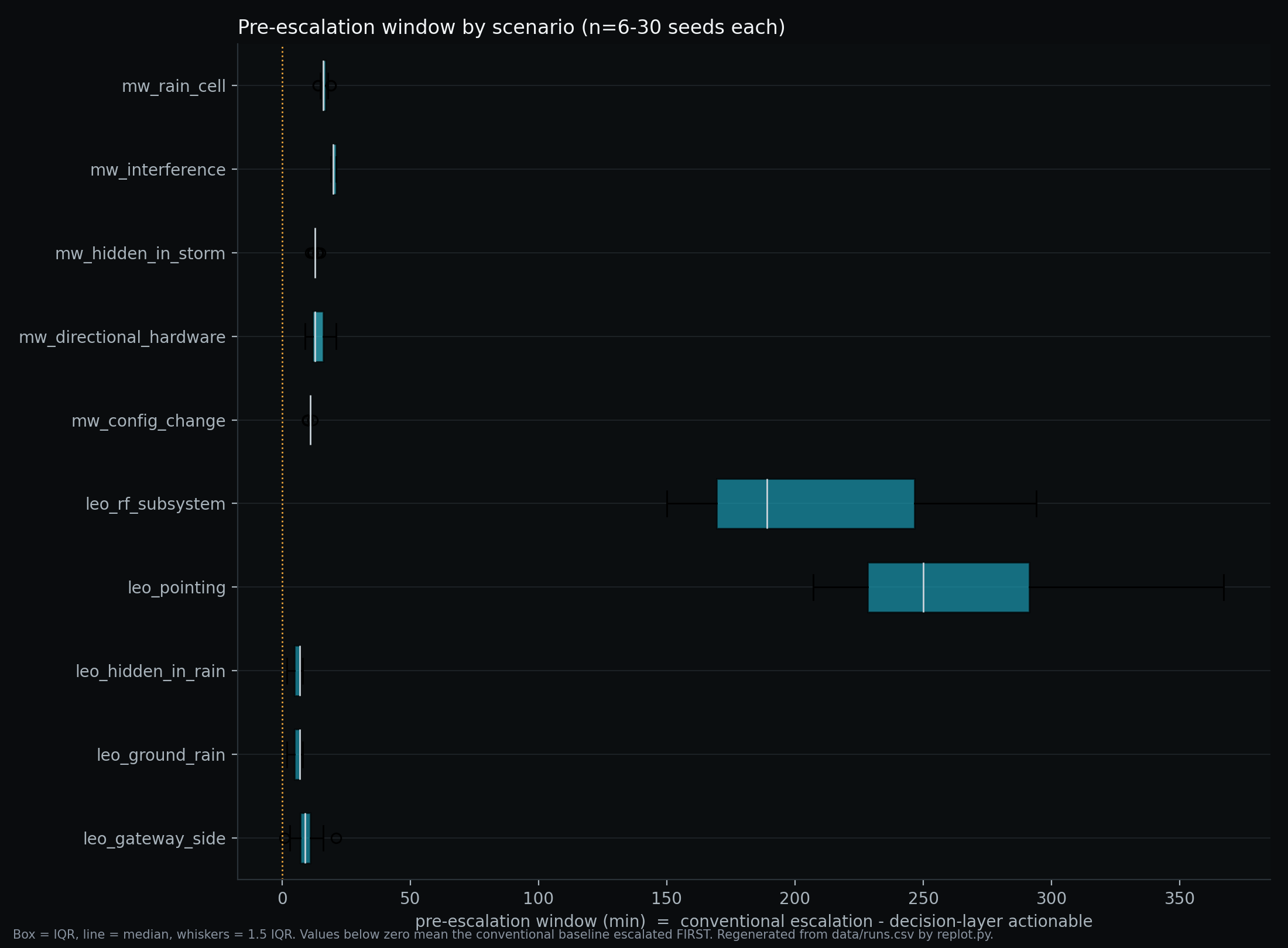
Pre-escalation window across simulated scenarios — the projected lead time varies by fault type and domain.
Per-run results — data/runs.csv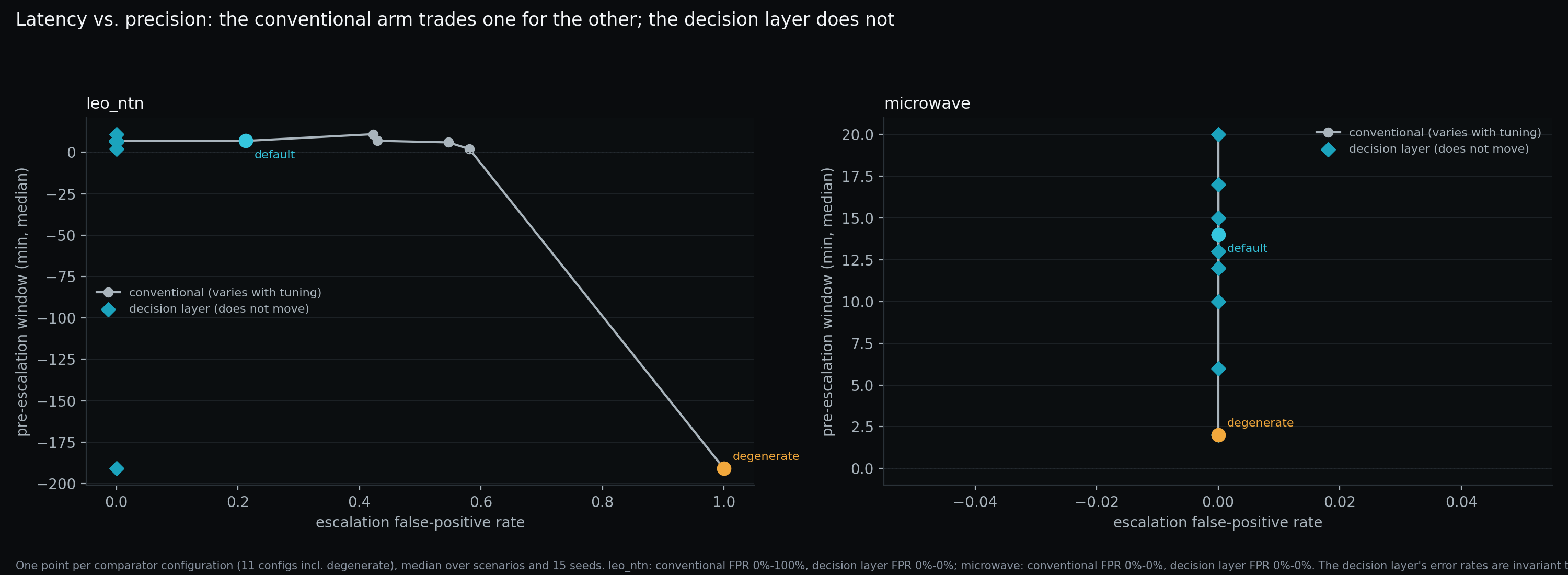
The pre-escalation window is not a fixed detection-speed advantage — it trades against precision as comparator sensitivity is tuned.
Comparator sensitivity sweep — data/sensitivity_comparator.csv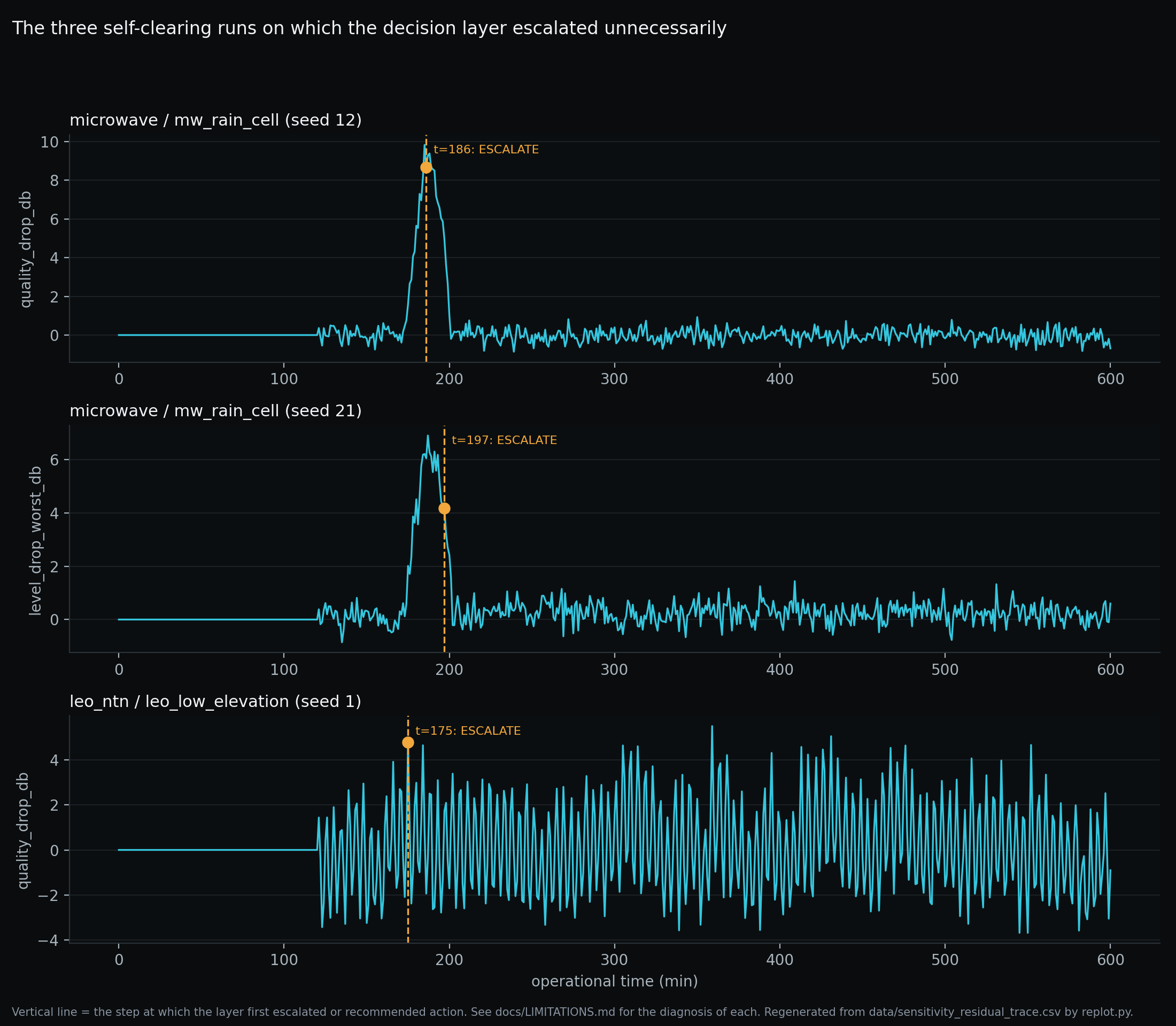
The three runs, out of the full sweep, where the decision layer itself escalated unnecessarily — published because a claim should show where it breaks, not only where it holds.
Residual diagnosis trace — data/sensitivity_residual_trace.csvSatellite & NTN Research
Preparing telecom intelligence for non-terrestrial environments
This research area focuses on preparing telecom intelligence architectures for satellite-assisted and non-terrestrial network (NTN) environments, where data characteristics, latency behavior, and security assumptions differ fundamentally from terrestrial networks.
1. Satellite Data Characterization
Analyzing telemetry structure, precision ranges, sparsity, and temporal dynamics across LEO and MEO satellite systems.
2. Terrestrial–NTN Data Alignment
How predictive models trained on terrestrial assumptions adapt for satellite-linked and hybrid architectures.
3. Security & Trust Boundary Analysis
Security implications of cross-border satellite links — moving trust zones and non-terrestrial exposure risks.
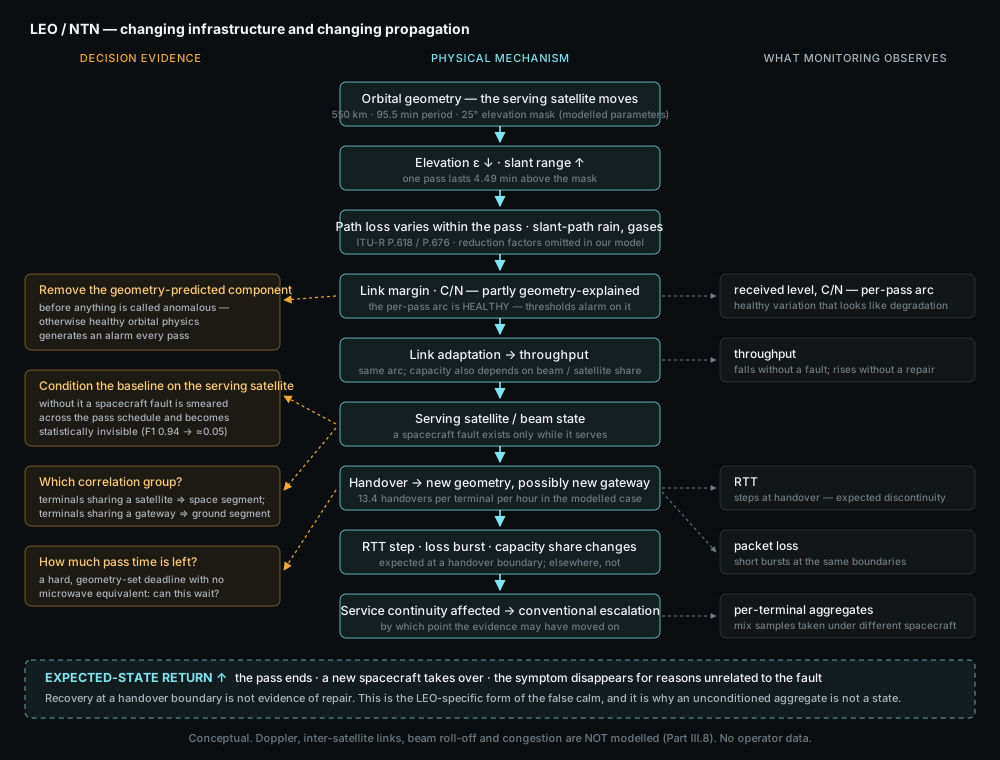
How a degradation in a LEO RF subsystem becomes an operational event — the non-terrestrial counterpart to the microwave causal chain.
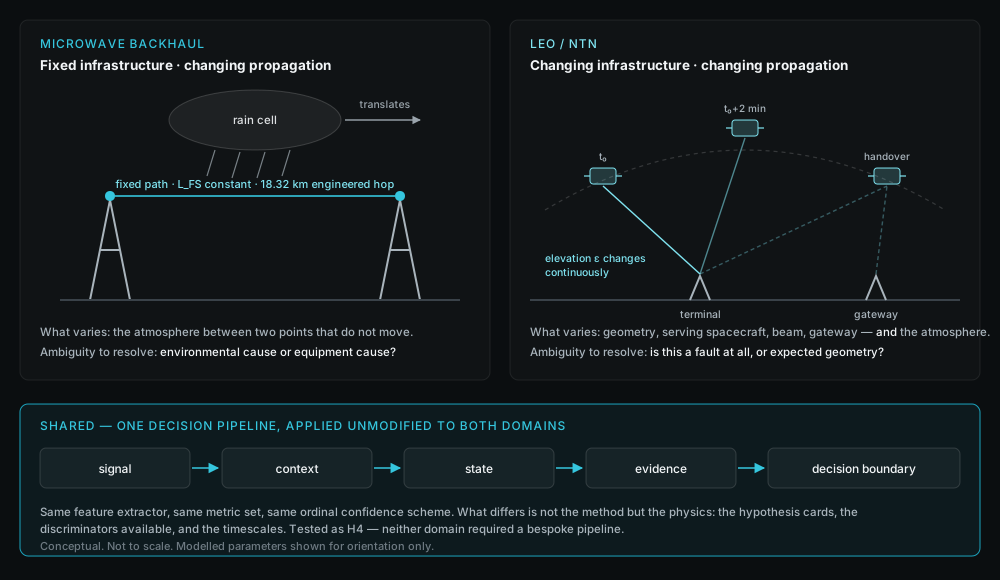
Where the pre-escalation mechanism generalizes across domains, and where each domain's physics diverges.
Status & Scope: this work represents architectural research and data exploration. It does not constitute a commercial satellite product, service, or deployment.
Historical Research Archive
Referenced in earlier publications
These research threads were named in earlier AID Edge publications. Full article text was not carried forward during this site's migration and is not represented here beyond title and topic — listed for the record, not as available reading.
- Advancing Telecom Security and Optimization with Federated Learning and Edge Computing
- Velorona.ai — Network Silence Is Not Health